You’re sitting in your living room. The lamp dims, brightens, then dims again. Most people brush it off. But lights flickering in house wiring is one of the most common reasons electricians get emergency calls each year.
Sometimes it’s nothing serious. A loose bulb. A cheap dimmer switch. Other times, it’s a warning sign of a real fire hazard hiding behind your walls. According to the National Fire Protection Association, electrical failures and malfunctions are a leading cause of U.S. home fires every year, and flickering is often one of the earliest visible symptoms.
This guide breaks down the main causes, the science behind why it happens, what you can safely fix yourself, and exactly when to put down the screwdriver and call a licensed electrician.
Quick Overview: Common Causes
| Cause | Severity | Fix |
| Loose light bulb | Low | Tighten the bulb |
| Bulb and dimmer mismatch | Low | Use a dimmable LED bulb |
| Overloaded circuit | Medium | Reduce load, unplug devices |
| Unbalanced ceiling fan | Medium | Re-balance or reinstall fan |
| LED driver failure | Medium | Replace fixture or driver |
| Shared neutral wire | High | Call a licensed electrician |
| Loose wiring or connection | High | Call a licensed electrician |
| Voltage fluctuations | High | Call a licensed electrician |
| Outdated electrical panel | High | Panel inspection or upgrade |
| Utility company issue | Varies | Check with your power provider |
| Storm or weather damage | Varies | Inspect lines, call utility company |
Lights Flickering in House Spiritual Meaning
Beyond the technical causes, many people search for the lights flickering in house spiritual meaning, especially when flickering happens at unusual moments, like right after thinking about a deceased loved one.
In folklore and spiritual tradition, some believe flickering lights signal a visiting spirit, a sign of energy in the home, or a loved one trying to make contact. These beliefs are part of long-standing cultural traditions across many parts of the world and hold genuine meaning for many people.
That said, they aren’t based on scientific evidence. If your lights are flickering, the safest and most responsible first step is always a practical one: check the bulb, check the circuit, and call an electrician if the issue persists.
Whatever you personally believe about energy or spirits, ruling out a fire hazard always comes first, for your safety and your home’s.
One Light Flickering in House: Start Here
If only one light flickering in the house is the issue, the cause is usually simple and safe to check yourself.

Tighten the Bulb
Turn off the power first. Let the bulb cool completely. Gently screw it in tighter. Loose bulbs are the most common cause of a single flickering fixture, and the fix takes less than a minute.
A loose bulb happens for a few reasons. Sometimes it’s just an imperfect install. Other times, vibration is the culprit.
A fixture mounted near a busy stairwell, a child’s playroom above, or a poorly balanced ceiling fan can shake a bulb loose over weeks or months without anyone noticing until the flicker starts.
Check Bulb and Socket Match
Not every bulb fits every socket the same way. Older fixtures sometimes have sockets that are slightly larger or smaller than modern standard bulbs.
Using the wrong wattage, or forcing an ill-fitting bulb into place, creates a poor connection that shows up as flickering. Always match the bulb type and wattage to the fixture’s rating.
Check Dimmer Compatibility
LED bulbs need a dimmer rated specifically for LED technology, not the older dimmers built for incandescent bulbs. This mismatch is one of the single most common causes of flicker in modern homes that recently switched to LED lighting.
Standard incandescent dimmers control brightness by simply cutting voltage, but LED bulbs use internal electronics called drivers that don’t always respond well to that kind of voltage cutting. The result is visible strobing, especially when dimmed low.
Why LED Lights Flicker More Than Older Bulbs?
LED lights can flicker more than older incandescent bulbs because they rely on electronic drivers. Unlike old bulbs that used steady heat-based glow, LEDs convert AC power into DC.
This conversion depends on a small driver, and low-quality drivers often create visible or hidden flicker. Dimmer switches, voltage changes, and poor heat control in recessed fixtures can make the problem worse.
Some LED flicker occurs at high frequencies like 100–120 Hz, which the eye may not fully notice but still causes discomfort or camera strobing. Replacing drivers or using compatible dimmers usually fixes most flicker issues quickly and improves safety.
Multiple Lights Flickering in House
When multiple lights flickering in a house happen across several rooms, the cause is usually bigger than one bulb, and it deserves closer attention.

Overloaded Circuits
This is a leading cause of multi-room flickering. If lights flicker only when a heavy appliance turns on, like a microwave, hair dryer, or space heater, that circuit is likely carrying more electrical load than it’s rated for.
This momentary power drain is called a voltage drop. Try unplugging some devices on the same circuit and see if the flickering stops. Older homes built before modern appliance loads became standard are especially prone to this issue.
Voltage Fluctuations
Voltage fluctuations can also cause multiple lights flickering in house at night or any time of day. These shifts come from damaged wiring, an overloaded system, or issues with the main utility connection feeding your home.
Voltage problems don’t just affect lights. Over time, they can quietly damage appliances, computers, and other electronics that depend on stable power.
Shared Neutral Wiring
Shared neutral wiring is a hidden issue in older homes that often causes flickering lights across multiple rooms. In multi-wire branch circuits, two circuits share one neutral wire.
If it becomes loose, voltage can become unbalanced, sometimes spiking near 240 volts. This can damage appliances and create safety risks. It needs professional inspection, not DIY repair.
Loose Wiring or Connections
Loose wiring is a separate but related concern. Wires can loosen behind walls due to age, poor original installation, accidental disruption during a renovation, or even animal interference, with rodents and insects sometimes chewing through insulation inside walls or attics.
This is not a DIY fix. A licensed electrician has the tools, including voltage testers and thermal cameras, to locate hidden breaks safely.
The Electrical Panel Connection
The electrical panel connection is the main point where power from the utility line enters your home system. It distributes electricity to all circuits through breakers or fuses. A loose or corroded connection inside the panel can cause unstable voltage, leading to flickering lights or random power drops.
In new construction, people often ask How Long Does It Take to Build a House. Electrical panel installation usually happens in the final stages. But poor wiring during construction can still cause long-term issues.
Studies show that poor electrical connections are a common cause of residential electrical failures. Over time, heat, moisture, and wear can weaken terminals and bus bars.
If the panel makes buzzing sounds, feels warm, or shows burning marks, it may indicate a dangerous connection issue. Regular inspection by a licensed electrician helps ensure safe and stable power distribution throughout the home.
GFCI Outlets and Flickering: A Less Obvious Connection
Ground Fault Circuit Interrupter outlets, commonly called GFCIs, are required by modern electrical code in kitchens, bathrooms, garages, and outdoor areas because they protect against electric shock by cutting power instantly when they detect a ground fault.
While GFCIs themselves don’t typically cause flickering lights directly, a failing or improperly wired GFCI on a shared circuit can sometimes contribute to inconsistent power delivery to nearby fixtures.
If your flickering coincides with a GFCI outlet that frequently trips or won’t reset properly, mention this detail to your electrician, since it can help narrow down the diagnosis significantly.
Lights Flickering in House During Storm or Rain
Weather plays a bigger role in flickering than most homeowners realize, and the causes here often have nothing to do with your home’s internal wiring at all.
During and After Storms
Lights flickering in house during storm events often trace back to issues outside the home entirely. Lightning striking near a transformer, falling tree branches hitting power lines, or storm-damaged utility equipment can all cause flickering, even when your home’s wiring is in perfect condition.
Lights flickering in house after a storm can mean lingering damage to your service line or nearby utility equipment, even after the weather clears completely. In storm-prone regions, some homeowners consider upgrading to a Hurricane Proof House standard.
Utility companies often continue stabilizing the grid for hours or days following a major storm, which can cause intermittent flickering as crews work through repairs.
Checking your utility company’s outage map is a quick way to rule out a grid-wide issue before assuming the problem is inside your home.
During Rain
Lights flickering in house during rain can point to water intrusion somewhere in your electrical system. A slow leak near wiring, especially around bathrooms, attics, or upper floors, can cause intermittent shorts.
The flickering may stop entirely once the area dries out, which makes the problem genuinely tricky to diagnose without a professional. If you only notice flickering while it’s actively raining, or shortly after, treat it as a sign of possible water intrusion near your wiring.
Do not attempt this kind of repair yourself. Water and live electrical wiring are an extremely dangerous combination, and even a small amount of moisture can create a short circuit capable of starting a fire.
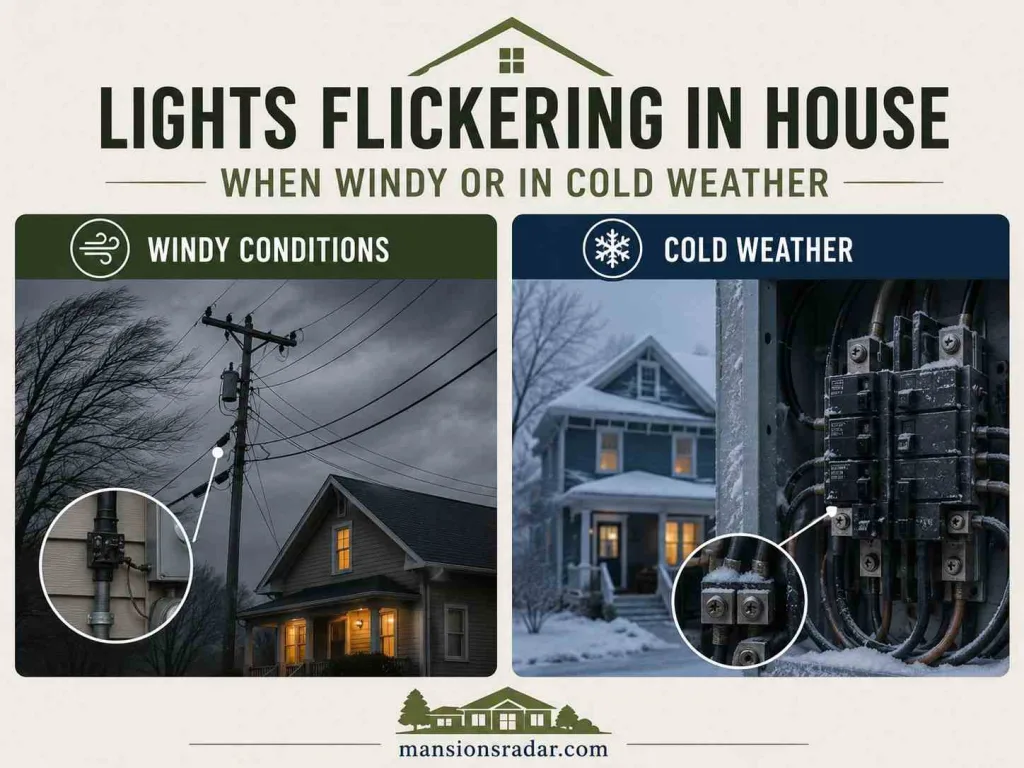
Lights Flickering in House When Windy or in Cold Weather
Wind and temperature swings both place physical stress on your home’s electrical connections in ways that are easy to overlook.
Windy Conditions
Lights flickering in house when windy often means there’s an issue with the power lines feeding your home, rather than your internal wiring.
Tree branches brushing against overhead lines, swaying utility poles, or a loose outdoor connection at your meter or service entrance can all create this exact pattern.
If the flickering only happens on windy days and stops once the wind dies down, the source is very likely outside your home.
Cold Weather
Lights flickering in house cold weather conditions can cause metal connectors and wiring materials to contract slightly. This thermal contraction can loosen already-weak connections inside your panel or wiring that may have gone unnoticed during warmer months.
If flickering shows up mainly during cold snaps and disappears as temperatures rise, it’s worth having an electrician check your panel and any exposed connections for looseness caused by repeated expansion and contraction cycles.
Lights Flickering in House When AC Is On
Lights flickering in house when AC is on is a common issue in many homes. It usually happens because the air conditioner compressor draws a high starting current. This surge, called inrush current, can be 3 to 7 times higher than normal running power.
When the AC starts, it briefly pulls extra electricity from the same circuit. If lights share that circuit, they may dim or flicker for a second.
Older wiring or overloaded electrical panels can make the problem worse. Installing a dedicated circuit for the AC often fixes the issue and keeps lighting stable during operation overall safety.
Lights Flickering in House All of a Sudden
Lights flickering in a house all of a sudden is usually a sign of an electrical change somewhere in the system. It can happen even if nothing obvious has been added or damaged. Loose wiring, worn-out switches, or a weak connection in the panel are common causes.
In many homes, voltage should stay around 220–240 volts, and even small drops can make bulbs flicker. Large appliances like refrigerators or air conditioners can also pull extra load and disturb stability.
Flickering happens randomly across rooms, it may indicate shared neutral issue or aging wiring that needs inspection by licensed electrician promptly.
When to Call an Electrician Immediately?
Some warning signs mean you should stop troubleshooting entirely and call a licensed electrician right away, regardless of how minor the flickering may seem:

- Flickering happens in multiple rooms or your entire house
- Lights flicker consistently, no matter what bulb, switch, or fixture is being used
- You smell burning or a fishy odor near outlets, switches, or your electrical panel
- Switches, outlets, or the breaker panel feel warm to the touch
- You hear buzzing or crackling sounds coming from outlets or the panel
- Breakers trip constantly, even after resetting
Any of these signs point toward arcing, a loose connection generating heat, or another genuine fire hazard. These are not situations to wait on or attempt to fix yourself. A licensed electrician can use thermal imaging, voltage testing, and panel inspection to pinpoint the exact source safely.
Why Are My Lights Flickering in One Room?
When flickering is isolated to a single space, the issue is usually local rather than home-wide. A bad dimmer switch, a single loose connection, a problem with that room’s specific circuit, or even a recently installed ceiling fan with an imbalanced motor are the most likely explanations.
If the flickering stays contained to one room over time and doesn’t spread, that’s actually a reassuring sign. It typically means the issue isn’t your electrical panel or a utility-side problem, and it’s more likely something straightforward like a fixture or local wiring issue that an electrician can resolve quickly.
Utility Company Issues
Utility company issues can cause sudden power flickering in many homes at once. Problems like aging transformers, loose neutral lines, or overloaded grid sections are common causes.
According to utility reports, transformer faults and connection issues account for a large share of neighborhood outages in older areas. Even a single damaged line at a utility pole can affect multiple houses.
If neighbors notice the same issue, it usually points to the power company, not inside wiring. Contacting the utility provider is the best first step for quick inspection and repair.
Conclusion
Lights flickering in house wiring can mean almost anything, from a simple loose bulb to a genuine fire hazard hiding behind your walls. The good news is that most causes are easy to identify once you know what to look for.
Start small: tighten the bulb, check your dimmer compatibility, and reduce the load on a busy circuit. If the flickering continues, especially across multiple rooms, alongside warm outlets, buzzing sounds, or strange smells, don’t wait it out.
Call a licensed electrician and get your home’s wiring properly checked. Your safety, and your family’s, is always worth the call.
Frequently Asked Questions
What causes lights flickering in house most often?
The most common causes are a loose bulb, an incompatible LED and dimmer pairing, or an overloaded circuit drawing too much power when an appliance turns on.
Are flickering lights a sign of evil or good energy?
This belief comes from folklore and spiritual tradition, not scientific evidence. Always rule out an electrical cause first before considering anything else.
Why are my lights flickering in one room only?
Isolated flickering usually points to a bad bulb, a faulty dimmer switch, an unbalanced ceiling fan, or a loose connection on that specific room’s circuit.
When should I call an electrician for flickering lights?
Call immediately if flickering affects multiple rooms, you smell burning, outlets or the panel feel warm, you hear buzzing, or breakers trip repeatedly.