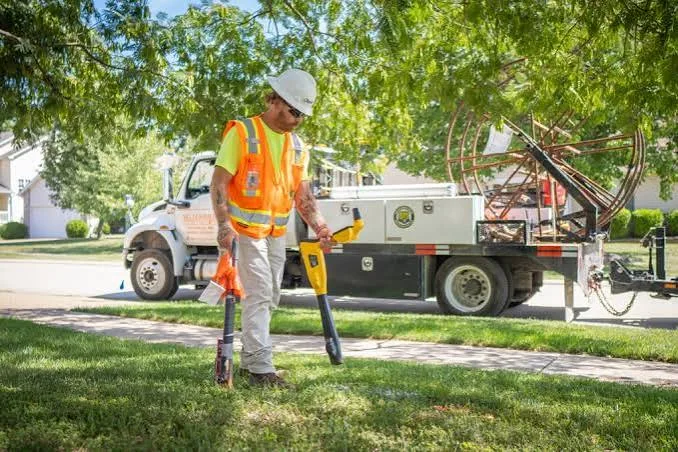
A utility detection package should match the work the contractor performs repeatedly. A crew tracing known conductive services needs a different starting kit from a team investigating unknown nonmetallic utilities or delivering mapped records.
A useful comparison of Radiodetection locating equipment begins with that distinction. The receiver should be evaluated together with the transmitter, signal accessories, operator skills and verification arrangements.
The practical objective is to give the crew a usable method for the likely target and a clear response when the evidence is incomplete. A longer equipment list does not automatically provide either.
Build the kit around the work, not the product category
Before requesting quotations, describe a representative month of work. Identify the service types, expected access points, frequency of congested sites and required customer records.
Those answers establish what should be owned, what can be hired and what needs a specialist.
| Recurring task | Starting capability | Additional decision |
| Trace a known conductive service | Receiver, compatible transmitter and signal accessories | How will the crew confirm the route and target? |
| Investigate a service without a usable conductive path | Complementary method appropriate to the target and site | Is specialist interpretation required? |
| Work near a critical crossing | Locating plus an agreed verification process | Who confirms physical position and clearance? |
| Deliver mapped observations | Suitable positioning and data workflow | Which attributes and quality checks does the customer require? |
This is a planning framework, not a guarantee that one instrument will detect every service in a category.
The core electromagnetic locating package
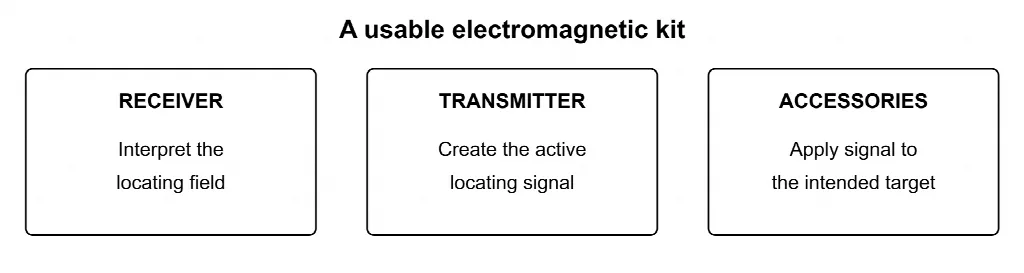
For repeated conductive-line work, evaluate the receiver and transmitter as one system. Include the accessories needed to put the signal onto the target.
Direct connection is a useful starting method where an approved connection is available. A compatible clamp expands options on accessible conductors. Induction supports searches when direct access is missing.
The comparison of signal application methods explains why these capabilities should be purchased as a set of practical options. A transmitter in the case does not establish that every application accessory is included.
Specify leads, connectors, power supplies, ground accessories, the required clamp and carrying protection. Ask the supplier to demonstrate the supplied configuration, rather than a separate demonstration kit.
Compatibility needs exact part numbers. A transmitter clamp and a receiver clamp are different components. A special function may also require a particular accessory or compatible frequencies.
Electrical access must follow the manufacturer’s instructions and the facility owner’s requirements. Energized connections require qualified personnel and approved products; equipment ownership does not confer that qualification.
When nonmetallic services require another method
An electromagnetic system needs a useful signal path. A service without one cannot be assumed locatable just because the receiver has many frequencies.
At that point, consider what evidence another method can provide. GPR can investigate subsurface features, but its usable depth and interpretation are site-dependent.
USDA guidance explains that higher soil conductivity associated with water, clay and soluble salts reduces radar performance. A detector purchase should therefore be preceded by an assessment of representative ground conditions.
For occasional difficult sites, the useful capability may be access to a competent specialist. Owning an instrument without the experience to interpret ambiguous data can leave the underlying problem unresolved.
Ask the provider to state what can be investigated, what remains uncertain and how the result will be recorded. Treat a non-detection as a limitation to evaluate, rather than proof that the area is clear.
Verification belongs in the equipment budget
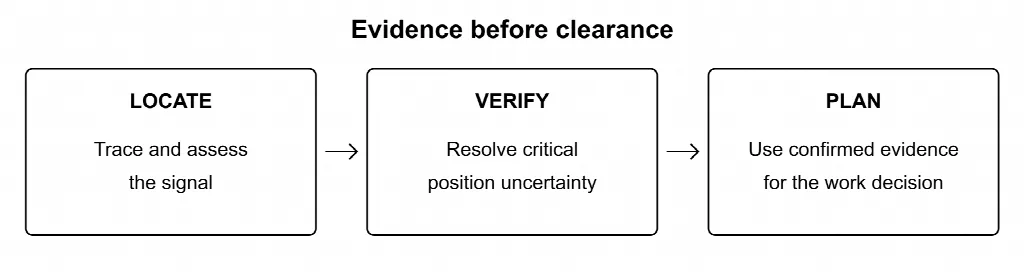
Locating and physical confirmation answer different questions. A receiver supports tracing and estimation; further verification may be necessary to establish a safe working clearance.
Radiodetection’s RD8200 manual warns against using the displayed depth to define mechanical digging depth. That constraint belongs in the job plan as well as the operator’s training.
Budget for the required verification method and the time needed to perform it. The exact arrangement depends on the site, utility and applicable procedures; a universal allowance would be misleading.
The review of underground utility strike costs distinguishes direct repair from broader interruption and societal costs. For a contractor’s decision, the important point is to identify its own exposure instead of using a national average as a prediction for the next incident.
Training and verification are operating capabilities. They should not be squeezed out simply to fit a more expensive receiver into a fixed budget.
Choose mapping functions only when the deliverable needs them
Mapping may be valuable when the client expects a digital record for later use. Radiodetection’s RD8200SG is an example of a system combining utility locating with GNSS RTK positioning.
Define the record first. Which coordinates, attributes, observations and uncertainty notes must be delivered? Who checks them? Where will they be stored?
Then evaluate the positioning system and data workflow against that requirement.
A precise surface position does not validate the buried utility interpretation. The record should preserve the distinction between an observed locate, an estimated depth and a physically confirmed point.
If the customer needs only an immediate field marking and a simple job record, assess whether additional mapping capability will be used often enough to justify its dependencies and cost.
Buy, rent or subcontract the specialist work
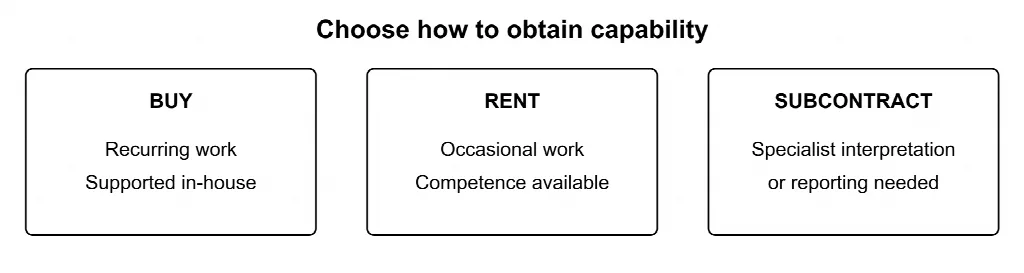
Ownership makes most sense when the equipment addresses recurring work and the company can support its operators, maintenance and verification process.
Rental can be worth evaluating for infrequent tasks where the contractor already has suitable competence. Subcontracting deserves consideration when interpretation and reporting skills are the main gap.
Compare options using the actual workload:
- Expected frequency of use and availability when needed.
- Training and supervision time.
- Complete accessory scope.
- Service and replacement arrangements.
- Mobilization requirements and reporting obligations.
Published receiver prices are a useful reference, but they do not establish the cost of the full capability. Obtain equivalent itemized quotes before deciding whether ownership is economical.
Avoid an assumed payback period built from invented productivity gains. Use completed-job records or a trial to estimate how the equipment changes the company’s own work.
Acceptance checks before a kit enters service
Start with the exact receiver, transmitter and accessory identifiers. Check the supplied items against the purchase scope, inspect their condition and review available service records.
Then perform a documented functional evaluation on a known target under the applicable operating procedure. Record the method, frequency and geometry so the result can be repeated.
Where depth is assessed, compare the display with the correct target reference: the centerline, rather than casually measuring to the top of a pipe. Include uncertain results in the record.
Finally, establish what the crew does when identification or position remains unresolved. The system is ready for use when its components work together and the operators understand both the useful evidence and its limits.